A board you play upwards
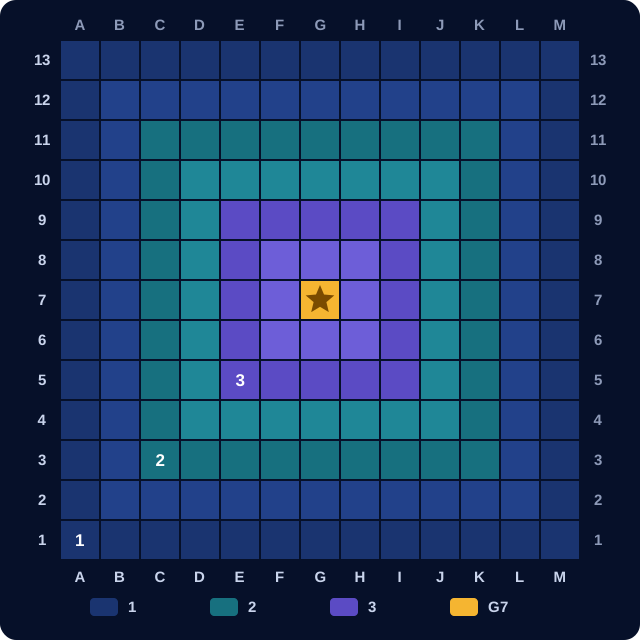
Seen from above, the board is a 13 × 13 grid (169 squares). Seen from the side, it is a pyramid with four floors and a single square at the top: the summit.
Blocks don't just move across the board; they climb and descend. To climb you need a step: another block, yours or your opponent's, to stand on. So every game is a race to build paths upwards while cutting off your opponent's.
The pieces: ten identical blocks
Each player has 10 blocks of their colour: nine common blocks and one special block. They all move the same way, in a straight line in any of eight directions. Only the special block can win by reaching the summit.
All blocks start off the board. On each turn you either bring a new block onto the board or move one that is already in play.
Dominating and capturing
When a block ends its move on top of another, it dominates it: the block underneath can't move while it is covered. If your colour becomes the majority in that column, the outnumbered blocks are captured and leave the game.
With dice, without dice, or both
XIMA has four modes. Science has no dice. Chance (Azar) uses two dice. In Cienzar you choose on every turn whether to move freely or roll. In Science vs Chance (Contrazar) one side plays without dice and the other with them. The XIMA book presents this mix of science and chance, Cienzar, as a new genre of game.
No draws
XIMA always has a winner. If a game gets stuck, nobody offers a draw: each player receives three extra common blocks and play goes on.
Video
Frequently asked questions
What is the goal of XIMA?
To bring your special block to the summit, square G7, with a legal move. The first player to do it wins.
Is XIMA a game of luck?
Only if you want it to be. Science mode has no dice at all; Chance mode uses two dice; Cienzar lets each player decide on every turn.
Who invented XIMA?
Yosdel Vicente Muiño Acevedo and Liz Power Suárez, in Havana, Cuba, in 2010.
Can I play XIMA for free?
Yes, at juegoxima.com, in the browser or on your phone.